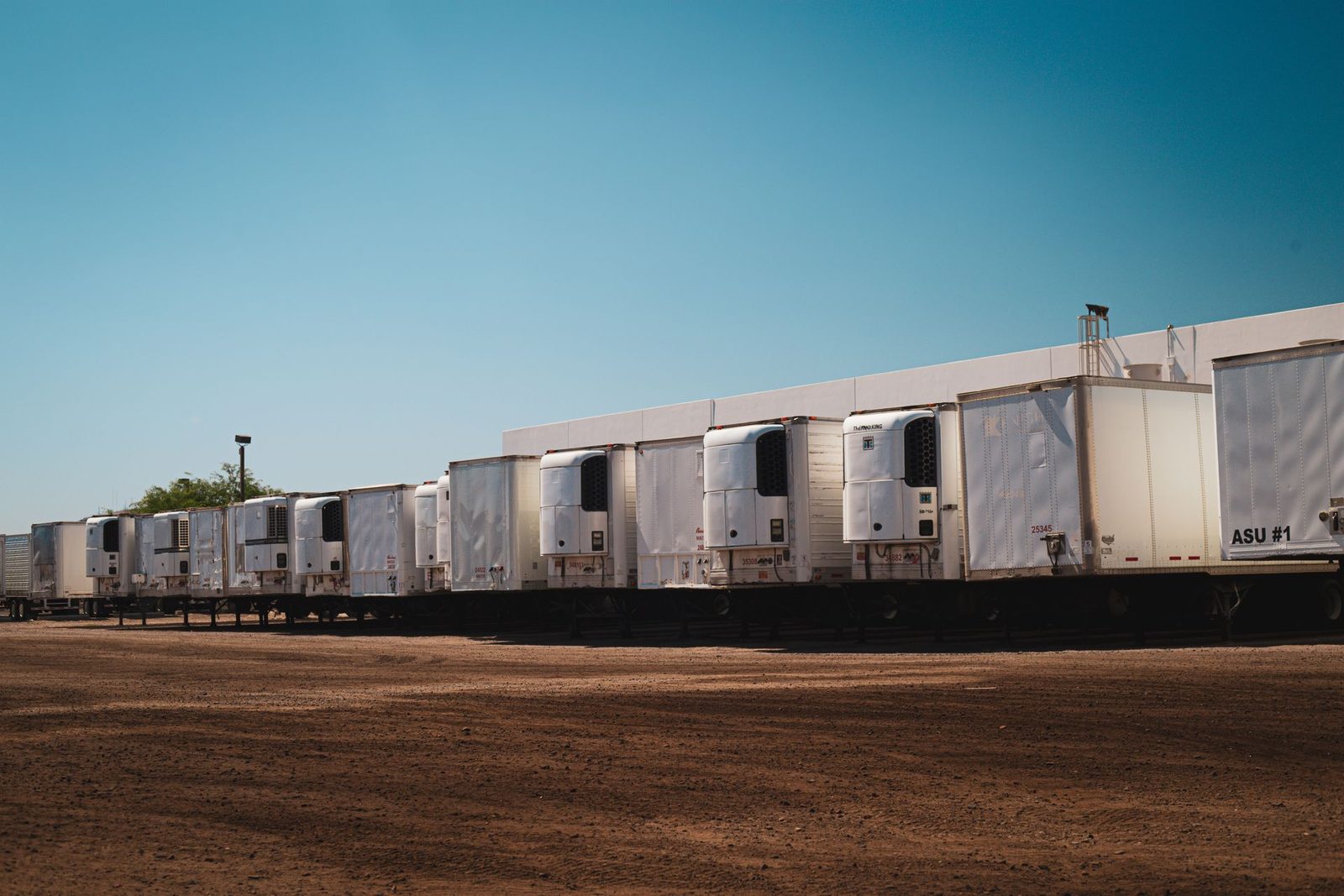
How passive cold-chain solutions can support food safety, pharmaceutical GDP, ATP, packaging and ESG requirements.
For Vietnamese food, pharmaceutical and other temperature-sensitive exporters, compliance is no longer limited to the product itself. The transport process must also demonstrate that temperature-sensitive goods have been handled under controlled and documented conditions.
This is where ATP-certified passive cooling solutions can create value. Rather than replacing every refrigerated vehicle, solutions such as Olivo insulated containers can provide a validated, traceable thermal environment for selected first-mile and last-mile operations and, where the validated profile permits it, selected air shipments.
From passive cooling to compliance by evidence. The objective is not to claim that an insulated container makes a company "HACCP compliant", "GDP compliant" or "ESG compliant". The value is more precise: a qualified and documented transport solution can provide technical evidence that supports an existing food-safety, pharmaceutical, customer-audit or sustainability system.
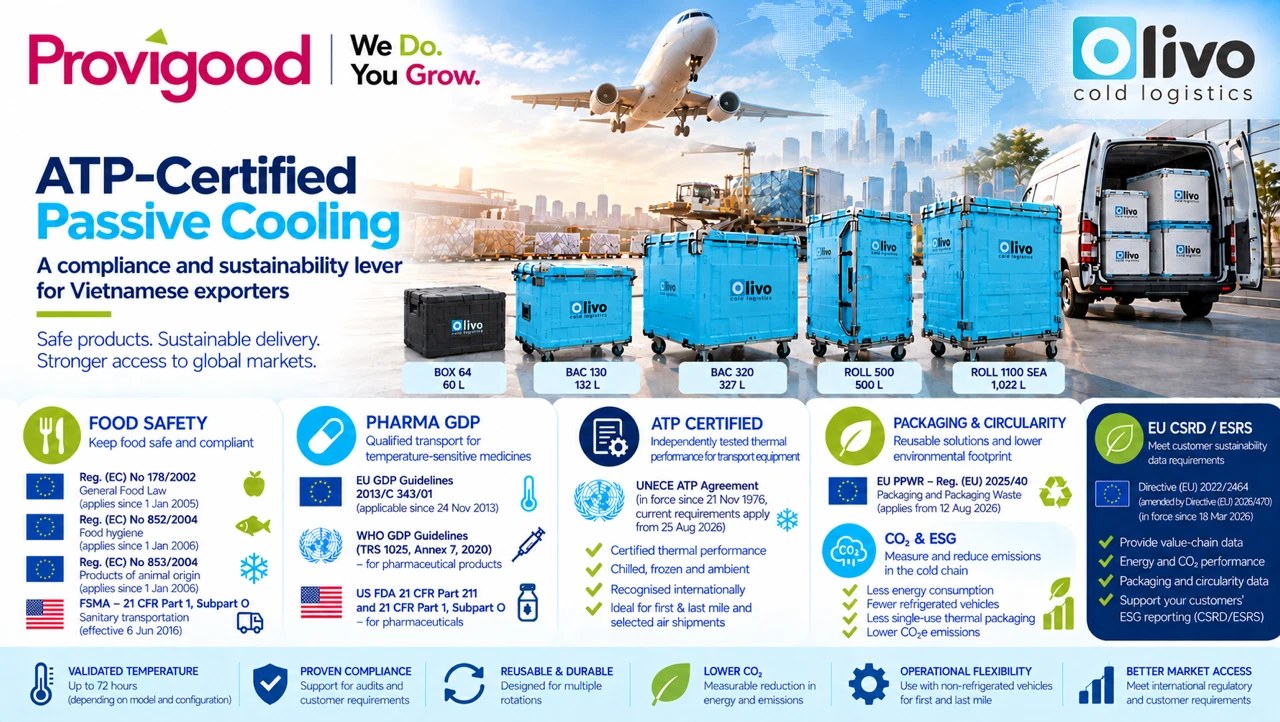
1. EU food law: traceability and controlled transport
Regulation (EC) No 178/2002 establishes the general principles of EU food law and requires traceability throughout the food chain. For exporters supplying the EU, the ability to document where products have been handled and under which conditions is therefore fundamental.
Olivo containers can support this evidence chain through controlled thermal transport and, on selected models, optional temperature/GPS tracking. The role is supportive: the exporter remains responsible for its overall food-safety and traceability system.
2. EU food hygiene: HACCP and temperature control
Regulation (EC) No 852/2004 on the hygiene of foodstuffs requires food-business operators to apply procedures based on HACCP principles and to ensure appropriate conditions during transport. For temperature-sensitive products, the transport configuration is therefore part of the control system.
A validated passive cooling configuration can help an exporter demonstrate how temperature is maintained during defined transport stages, particularly during first-mile collection, cross-docking and last-mile delivery.
3. Products of animal origin and fishery products
Regulation (EC) No 853/2004 contains specific temperature requirements for products of animal origin. For frozen fishery products, the general requirement is a product temperature of no more than −18°C, subject to the regulation's permitted short upward fluctuation.
This makes thermal performance particularly important for Vietnamese seafood exporters. The relevant Olivo configuration must be selected and validated against the product, target temperature, ambient conditions, loading pattern and expected duration.
4. United States: FSMA Sanitary Transportation
Under the U.S. Food Safety Modernization Act (FSMA), the Sanitary Transportation of Human and Animal Food rule (21 CFR Part 1, Subpart O) establishes requirements designed to prevent food from becoming unsafe during transportation.
For exporters shipping to the United States, controlled transport procedures and appropriate equipment are therefore relevant. Passive cooling can be used as one element of a documented transport-control strategy when the configuration is suitable for the product and journey.
5. Pharmaceutical distribution: EU GDP and WHO guidance
The EU Guidelines on Good Distribution Practice of medicinal products for human use (2013/C 343/01) require storage and transport conditions to be maintained and risk-assessed. The guidelines specifically recognise qualified thermal packaging, temperature-controlled containers and vehicles, as well as temperature monitoring and route-risk assessment.
WHO guidance, including Technical Report Series No. 1025, Annex 7, reinforces the importance of good storage and distribution practices, qualification and monitoring for medical products. For U.S. pharmaceutical manufacturing and distribution, 21 CFR 211.150 also requires written procedures for distribution and control of drug products.
For exporters, the practical lesson is clear: passive cooling can be part of a qualified shipping solution, but the qualification must be linked to the actual product, packaging configuration, route and temperature profile.
6. UNECE ATP: the most direct regulatory link
The UNECE Agreement on the International Carriage of Perishable Foodstuffs (ATP) is the most direct regulatory reference for insulated transport equipment. ATP establishes requirements and testing procedures for special equipment used to transport perishable foodstuffs.
This is particularly relevant to Olivo because selected Olivo passive cooling solutions are ATP-certified. ATP therefore provides a direct equipment-performance reference, while food or pharmaceutical regulations define the broader product and distribution requirements.
7. EU Packaging and Packaging Waste Regulation (PPWR)
Regulation (EU) 2025/40 on packaging and packaging waste entered into force on 11 February 2025 and applies from 12 August 2026. It strengthens the EU's focus on packaging waste prevention, reuse and circularity.
Reusable insulated transport solutions can support a reusable-packaging strategy by replacing some single-use transport materials and enabling repeated rotations. The precise legal classification and applicability of PPWR requirements depend on the packaging configuration and how it is used in the supply chain.
8. EU CSRD / ESRS: sustainability evidence and customer pressure
The EU Corporate Sustainability Reporting Directive (CSRD), as amended in 2026 by Directive (EU) 2026/470, now has a narrower mandatory scope. Under the revised framework, mandatory reporting generally applies to undertakings exceeding €450 million in net turnover and employing more than 1,000 people on average, subject to the directive's detailed conditions.
Most Vietnamese exporters will not therefore be directly subject to CSRD. However, CSRD and the European Sustainability Reporting Standards (ESRS) can still matter commercially through customers, parent companies, procurement requirements and value-chain data requests. The revised framework also introduces safeguards around value-chain information requests and a voluntary sustainability reporting standard for smaller companies.
For exporters, the opportunity is to generate reliable operational evidence: transport energy use, avoided refrigeration, reusable-container rotations, packaging reduction and, where properly calculated, associated emissions data. Olivo can contribute to the operational evidence base, but does not itself make a company "ESG compliant".
9. EU F-gas Regulation: an indirect sustainability lever
Regulation (EU) 2024/573 strengthens the EU framework governing fluorinated greenhouse gases and introduces further restrictions on certain high-GWP refrigerants and equipment.
Passive cooling does not use a compressor or refrigerant circuit during transport. In the right operating model, it can therefore reduce reliance on mechanically refrigerated transport for selected legs. This is an indirect sustainability benefit rather than a claim of direct F-gas compliance.
Where Olivo can create regulatory value
Framework by framework, the main concern and the potential Olivo contribution:
- EU 178/2002 (traceability): controlled transport evidence; optional temperature/GPS tracking.
- EU 852/2004 (hygiene, HACCP-based controls): supports documented temperature-control procedures.
- EU 853/2004 (animal-origin and fishery temperatures): validated thermal configuration for defined temperature profiles.
- US FSMA, 21 CFR Part 1 Subpart O (sanitary transportation): controlled transport solution within a documented process.
- EU GDP 2013/C 343/01 (medicinal-product distribution): qualified thermal packaging and containers, monitoring and route-risk evidence.
- WHO TRS 1025 Annex 7 (medical-product distribution): qualification and monitoring support.
- UNECE ATP (thermal performance of transport equipment): direct relevance through ATP-certified passive cooling solutions.
- EU PPWR 2025/40 (reuse and packaging waste): supports reusable transport-packaging models and reduced single-use materials.
- EU CSRD / ESRS (sustainability data, value chain): operational evidence for energy, emissions and reusable-container metrics.
- EU F-gas 2024/573 (refrigerants, greenhouse gases): potentially reduces dependence on mechanical refrigeration for selected transport legs.
From passive cooling to compliance by evidence
The strongest business case is not simply "we have an insulated box". It is the ability to connect a qualified transport solution to documented operating procedures and measurable results.
- Define the required temperature range and maximum transport duration.
- Select the appropriate Olivo container and eutectic-plate configuration.
- Validate the configuration against the product, loading pattern and route.
- Document preparation, loading, handover and monitoring procedures.
- Retain temperature and, where available, tracking data as objective evidence.
- Measure reusable-container rotations, avoided refrigeration and relevant operational impacts.
- Integrate the evidence into the exporter's HACCP, GDP, customer-audit and sustainability documentation as appropriate.
Important: Olivo solutions are not a substitute for a company's HACCP system, GDP qualification, pharmaceutical quality system, regulatory approvals or ESG reporting framework. Their value is as qualified transport equipment and supporting technical evidence within those systems.
Provigood — We Do. You Grow. Authorized distributor of Olivo Cold Logistics in Vietnam and Cambodia.
Sources and references
- European Commission / EUR-Lex — Regulation (EC) No 178/2002 (general food law).
- European Commission / EUR-Lex — Regulation (EC) No 852/2004 (hygiene of foodstuffs).
- European Commission / EUR-Lex — Regulation (EC) No 853/2004 (products of animal origin).
- FDA — Sanitary Transportation of Human and Animal Food, 21 CFR Part 1 Subpart O.
- European Commission / EUR-Lex — EU GDP Guidelines 2013/C 343/01.
- WHO — Technical Report Series No. 1025, Annex 7.
- UNECE — ATP Agreement.
- European Commission / EUR-Lex — Regulation (EU) 2025/40 (PPWR).
- European Commission / EUR-Lex — Directive (EU) 2026/470 (CSRD amendments).
- European Commission — Revised ESRS, 3 July 2026.
- European Commission / EUR-Lex — Regulation (EU) 2024/573 (F-gases).
- FDA / eCFR — 21 CFR 211.150, distribution procedures.