The business case for integrating passive cold chain from day one.
Core principle: design the logistics system, not just the warehouse. Food safety, logistics flows, cooling technology, containers, vehicles, routes, operating procedures and ESG objectives must be considered together.
1. Design the logistics system before the warehouse
When planning a new distribution centre handling frozen, chilled and ambient products, the project should start with food-safety requirements, logistics flows and environmental objectives, not the building itself.
Warehouse layout, cooling infrastructure, insulated containers, vehicles, delivery routes and operating procedures must be designed as one integrated system. Early planning can prevent unnecessary investment and identify opportunities to improve productivity, vehicle utilisation and environmental performance.
2. Define food safety and ESG objectives upfront
Establish the required temperatures, permitted exposure times, product segregation, hygiene, cleaning and traceability requirements before selecting equipment. Raw and cooked products, incompatible goods and other categories requiring separation must be handled appropriately throughout storage, preparation and transport.
Vietnam's Law on Food Safety No. 55/2010/QH12, particularly Articles 20 and 21, provides an important legal basis for food preservation and transportation. Article 20 addresses storage conditions, including separate storage for different food types; Article 21 addresses food transportation and preservation conditions. Applicable product-specific regulations and technical standards must also be checked.
Reference: Official Vietnamese Government portal, Law No. 55/2010/QH12 on Food Safety.
Define measurable objectives for energy consumption, greenhouse-gas emissions, reusable packaging, plastic-waste reduction and food-waste prevention. Relevant legislation includes the Law on Environmental Protection No. 72/2020/QH14, especially Article 142 on the circular economy, and the energy-efficiency framework: Law No. 77/2025/QH15 (effective 1 January 2026) and Decree No. 30/2026/ND-CP (effective 21 January 2026).
Reference: Law No. 72/2020/QH14 on Environmental Protection.
Reference: Law No. 77/2025/QH15, amended energy-efficiency law.
Reference: Decree No. 30/2026/ND-CP, implementation of the energy-efficiency law.
For greenhouse-gas obligations, Decree No. 06/2022/ND-CP has been amended, including by Decrees No. 119/2025/ND-CP and No. 83/2026/ND-CP. Which inventory, reporting or reduction obligations apply must be assessed for the specific operator and facility.
Reference: Decree No. 83/2026/ND-CP, amendments to greenhouse-gas and ozone-layer rules.
3. Plan the flows, routes, containers and cooling systems together
Map product volumes, customer locations, delivery schedules, route durations, loading and unloading times, peak demand and container-return flows. Include the time and space required to regenerate cooling sources and to return, clean and inspect reusable containers.
Select containers and cooling sources according to actual temperatures, payloads, thermal autonomy and regeneration requirements. Reusable insulated containers with eutectic plates may suit shorter or single-temperature routes. Selected Olivo BOX solutions provide autonomy of up to 12 hours, while certain BAC and ROLL solutions offer up to 72 hours, depending on configuration and operating conditions.
For appropriate applications, the SIBER SYSTEM® may also be considered. Where required, its design must anticipate CO₂ supply infrastructure, technical installations and safety provisions. The installation should be assessed by competent engineering and safety specialists; an outdoor CO₂ tank is not a universal requirement for every passive cold-chain solution.
Reference: Olivo, eutectic plates or SIBER SYSTEM®: choosing a cooling source.
Vehicle types, sizes and payloads should match the containers and routes. Suitable tail lifts should be included wherever necessary to enable faster, safer and less physically demanding loading and unloading, especially where suitable loading docks or customer-side equipment are unavailable.
Research supports integrating warehouse preparation and vehicle-routing decisions rather than optimising them independently. Rijal, Bijvank and De Koster's 2023 study models order batching, picker scheduling, staging and vehicle loading together. In two retailer warehouse case studies, integrated planning produced cost savings of approximately 9% and 11%; these are case-specific results, not guaranteed savings for a new project.
4. Design the warehouse around the selected operating model
The layout should accommodate order preparation, product segregation, consolidation, container storage, cooling-source regeneration, loading docks, cleaning and returns.
The selected technology may affect freezing capacity, refrigeration equipment, utilities and CO₂ infrastructure. These requirements should be established before architectural and engineering plans are finalised.
The objective is to identify the appropriate combination of active refrigeration and passive cold-chain solutions for each flow, rather than assuming that passive cooling can replace all conventional refrigeration. Any reduction in refrigerated space or equipment should be supported by a documented operational and financial assessment.
5. Establish procedures and train the teams
Document procedures for container preparation, cooling-source installation, temperature checks, segregation, order preparation, loading, unloading, cleaning, maintenance, returns and exception management. Loading plans should reflect vehicle configuration, load securing, delivery sequence and the use of tail lifts where needed.
Warehouse staff, drivers, supervisors and quality teams need practical training. Pilot deliveries and a controlled ramp-up period should be included in the implementation plan. The new operating model should be validated before full deployment, with sufficient time for employees to master the equipment and procedures.
A technically sound solution may underperform if teams are not trained or if the actual procedures do not fit the warehouse and delivery constraints.
6. Estimate the economic and environmental value
The business case should distinguish direct savings from broader operational improvements. The following scenario estimates gross refrigeration-fuel savings for a hypothetical 10-truck operation. It is an illustration, not a client forecast.
| Assumption / result | Conservative | Central | Higher potential |
|---|---|---|---|
| Trucks | 10 | 10 | 10 |
| Trips per truck per day | 2 | 2 | 2 |
| Operating days per year | 300 | 300 | 300 |
| Total annual trips | 6,000 | 6,000 | 6,000 |
| Trips potentially suitable for passive cooling | 3,000 | 3,000 | 3,000 |
| Refrigeration hours avoided per eligible trip | 1 | 2 | 3 |
| Diesel avoided annually | 9,000 L | 18,000 L | 27,000 L |
| Gross refrigeration-fuel savings | VND 262 million | VND 524 million | VND 786 million |
| Direct CO₂ emissions avoided (indicative) | 24.4 t | 48.8 t | 73.1 t |
Illustrative assumptions: 3 litres of diesel per refrigeration-unit operating hour; 3,000 potentially eligible trips annually; and a diesel price of VND 29,128 per litre, the published Vietnamese market price on 8 October 2026. The direct-emissions estimate uses an indicative factor of 2.709 kg of CO₂ per litre of diesel.
Reference: Vietnam Ministry of Industry and Trade, fuel-price information, 8 October 2026.
These figures represent gross avoided refrigeration-fuel costs only. They exclude eutectic-plate regeneration, electricity, containers, cooling-source consumables, infrastructure, maintenance, financing and implementation. They also exclude potential savings from route consolidation, reduced vehicle requirements, labour, avoided product losses and disposable packaging. The central estimate of VND 524 million is therefore not a forecast of net savings or ROI.
An experimental study of a specific phase-change-material (PCM) passive container for integrated road-rail cold-chain transport reported internal temperature maintenance at 2 to 8°C for up to 94.6 hours. Compared with a diesel-powered refrigerated container in that study, energy consumption was 86.7% lower, operating cost 91.6% lower and emissions 78.5% lower. These results demonstrate technical potential but should not be transferred directly to an urban delivery fleet or treated as guaranteed savings.
Additional value may come from better vehicle utilisation, fewer unnecessary trips, smoother loading and unloading, reusable packaging, reduced waste and improved temperature control. Each benefit must be quantified using customer-specific operational data. The environmental assessment should include cooling-source regeneration, return logistics, cleaning, container lifespan and end-of-life treatment.
7. Assess the circular-economy potential
Vietnam's Law on Environmental Protection No. 72/2020/QH14, Article 142, defines the circular-economy model around reducing raw-material use, extending product life, reducing waste and minimising adverse environmental impacts. It also calls for resource and waste management, reuse and recycling to be considered from project formulation and product design.
Reference: Law No. 72/2020/QH14, Article 142, circular economy.
Decree No. 08/2022/ND-CP, as amended, is relevant to environmental management and applicable restrictions on single-use plastics. Decision No. 21/2025/QĐ-TTg establishes environmental criteria and a process for confirming investment projects within Vietnam's green classification list; it has been effective since 22 August 2025.
Reference: Decision No. 21/2025/QĐ-TTg, green investment project criteria.
Decision No. 46/2026/QĐ-TTg was issued on 17 September 2026 and is scheduled to enter into force on 1 November 2026. It addresses the identification of green projects, projects meeting circular-economy criteria and the application of an environmental, social and governance (ESG) framework. As of 9 October 2026, it is not yet in force, but its criteria can be considered when preparing the project.
Reference: Decision No. 46/2026/QĐ-TTg, official Government Gazette record and effective date.
A distribution centre using durable reusable containers, avoiding disposable packaging and measuring energy and emissions may contribute to circular-economy objectives. Formal recognition as a green or circular-economy project cannot be assumed simply because passive cold-chain technology is used.
The project should establish baselines and targets for container rotations, packaging avoided, energy consumption, emissions and waste, and assess the applicable criteria with qualified Vietnamese legal and environmental specialists. Any claim of green-financing eligibility or formal recognition should be made only after the relevant criteria have been assessed.
8. Follow an integrated design process
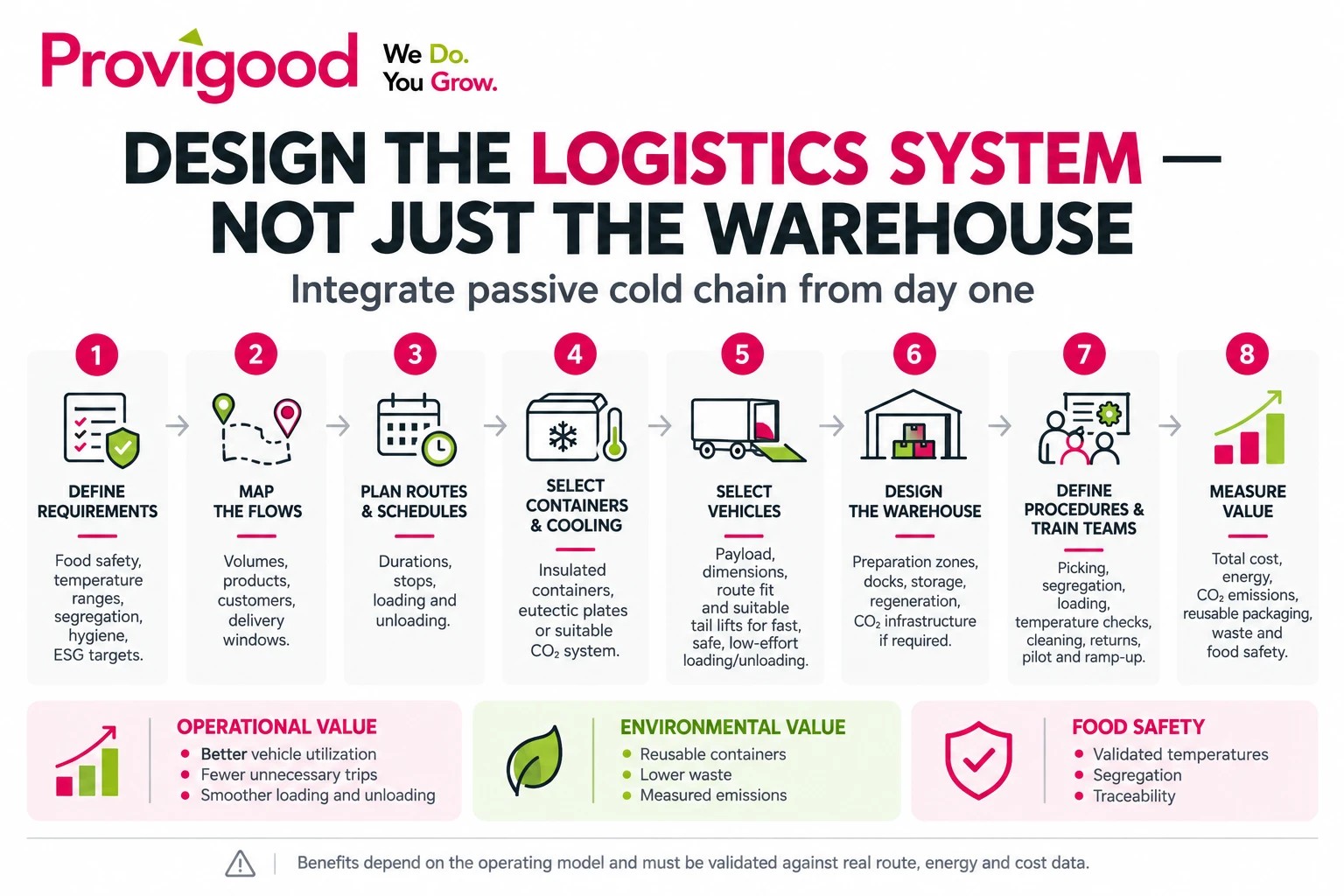
- Define food-safety, operational, ESG and regulatory objectives.
- Map product flows, delivery routes and schedules, including returns.
- Select containers, cooling sources and regeneration systems.
- Select vehicles, payload capacities and suitable tail lifts.
- Design the warehouse, technical installations, preparation zones and loading areas.
- Establish procedures for preparation, segregation, loading, unloading, cleaning and returns.
- Train the teams, conduct pilot operations and validate performance.
- Measure total cost, service quality, energy, emissions, waste and container reuse.
These steps should be coordinated and refined together before the final investment decision. The process is integrated and iterative: route assumptions may change container choices, vehicle choices may affect loading areas, and pilot results may require adjustments to procedures or infrastructure.
Conclusion: design the logistics system, not just the warehouse
Passive cold-chain solutions can create economic and environmental value when integrated into the logistics model from the earliest design stage. The opportunity extends beyond avoiding refrigeration fuel: it may include better vehicle utilisation, more efficient warehouse operations, reusable packaging, improved food-safety control and measurable ESG performance.
The actual value must be established through a customer-specific total-cost-of-ownership model, validated operating data and a comparison of complete scenarios. Published results from other applications demonstrate technical potential, but they do not replace a site-specific business case.
Define the requirements. Plan the routes. Select the containers, cooling systems, vehicles and tail lifts. Establish the procedures. Train the teams. Then finalise the warehouse design.
Provigood and Olivo can help operators turn these principles into a quantified investment case, with clear operational assumptions, measurable environmental targets and a credible implementation plan.
Provigood — We Do. You Grow. Authorized distributor of Olivo Cold Logistics in Vietnam and Cambodia.