How passive cooling can help Vietnam's 500-store convenience retailers build a safer, greener and more resilient cold chain.
A business case for Olivo insulated containers, multi-temperature distribution and measurable ESG value in Vietnam's evolving regulatory environment.
Executive summary
A 500-store convenience retailer could potentially reduce duplicated deliveries and improve temperature control by combining ambient vehicles with validated Olivo insulated containers for chilled and frozen products. This model is most relevant to short- and medium-distance, multi-stop routes with variable temperature-controlled volumes; it does not replace refrigerated trucks in every application.
- Annual delivery trips declining from 15,429 to 6,858.
- Modeled annual transport costs declining from VND 36.5 billion to VND 20.2 billion.
- A modeled gross transport-cost difference of VND 16.3 billion per year.
- Indicative equipment investment of VND 24.4 billion.
- An illustrative gross-savings payback of approximately 18 months.
These figures are planning assumptions, not audited results or verified net savings. The VND 16.3 billion represents the difference between two modeled transport scenarios. It does not yet deduct all incremental costs associated with passive cooling, including eutectic-plate preparation, cleaning, maintenance, reverse logistics, additional handling, warehouse changes, training, monitoring and possible store-labour impacts.
Investment recommendation: approve a route-level audit and a controlled pilot, not a network-wide deployment. The pilot should validate service levels, temperature performance, equipment requirements, incremental operating costs and total cost of ownership before any scale-up decision.
The investment committee should require the pilot to produce:
- A reconciled baseline and pilot cost comparison.
- Verified gross savings and a complete incremental-cost schedule.
- A five- or seven-year total-cost-of-ownership model.
- Downside, base and upside sensitivity cases.
- Food-safety, service-level, packaging, waste and emissions results.
- A validated net-benefit payback calculation.
The broader opportunity is to combine transport efficiency with stronger food-safety control, lower product losses, reduced disposable packaging and better emissions data. These additional benefits should be measured separately and added to the financial case only when verified and not double-counted.
1. A new challenge for Vietnam's convenience retail sector
Vietnam's convenience retail market faces a complex operational challenge: supplying hundreds of stores with fresh, chilled, frozen and ambient products while maintaining food safety, controlling logistics costs and reducing environmental impact.
For a retailer operating 500 convenience stores, traditional distribution models can create significant inefficiencies. Separate deliveries for ambient, chilled and frozen products may lead to duplicated journeys, underutilised vehicles, higher fuel consumption and more complex store operations. Refrigerated vehicles may also spend substantial time operating with only part of their cargo capacity occupied by temperature-controlled products.
At the same time, retailers face growing expectations concerning food safety, waste reduction, energy efficiency, packaging and greenhouse-gas emissions. Vietnam's regulatory framework reinforces the importance of these issues:
- Food safety: Law No. 55/2010/QH12 on Food Safety establishes requirements for food preservation and transportation.
- Environmental protection: Law No. 72/2020/QH14 on Environmental Protection provides the framework for waste management, extended producer responsibility and greenhouse-gas mitigation.
- Energy efficiency: Law No. 50/2010/QH12, as amended by Law No. 77/2025/QH15, and Decree No. 30/2026/ND-CP strengthen the framework for economical and efficient energy use.
- Climate action: Vietnam's National Climate Change Strategy to 2050, approved under Decision No. 896/QĐ-TTg, establishes the national ambition of net-zero greenhouse-gas emissions by 2050.
These policies do not prescribe passive cooling as a universal replacement for refrigerated transport. However, they provide a relevant context for retailers seeking to improve the efficiency, safety and environmental performance of their supply chains.
The strategic question is broader than reducing transportation costs:
How can retailers redesign cold-chain operations to create measurable financial, food-safety and ESG value simultaneously?
2. Passive cooling versus refrigerated trucks: selecting the right technology
Refrigerated trucks remain essential for large temperature-controlled loads, long-distance transport, operations requiring continuous refrigeration and journeys with uncertain durations. However, the economics can change significantly during short- and medium-distance urban and suburban deliveries.
For routes with multiple stops, variable chilled volumes and several temperature requirements, refrigerated trucks may be cooling a large cargo space even when only a fraction of its capacity contains temperature-controlled products.
Passive cooling takes a different approach. Olivo Cold Logistics manufactures insulated containers designed to maintain products within validated temperature ranges using preconditioned eutectic plates, without requiring a mechanical refrigeration unit inside the transport vehicle. Depending on the model and operating conditions, thermal autonomy can extend up to 72 hours.
The principle is straightforward: instead of refrigerating the entire truck, protect the products that actually need temperature control. A conventional ambient truck can then transport dry products alongside separate insulated containers for chilled and frozen products, provided the container configuration, product segregation, route duration and thermal performance have been validated.
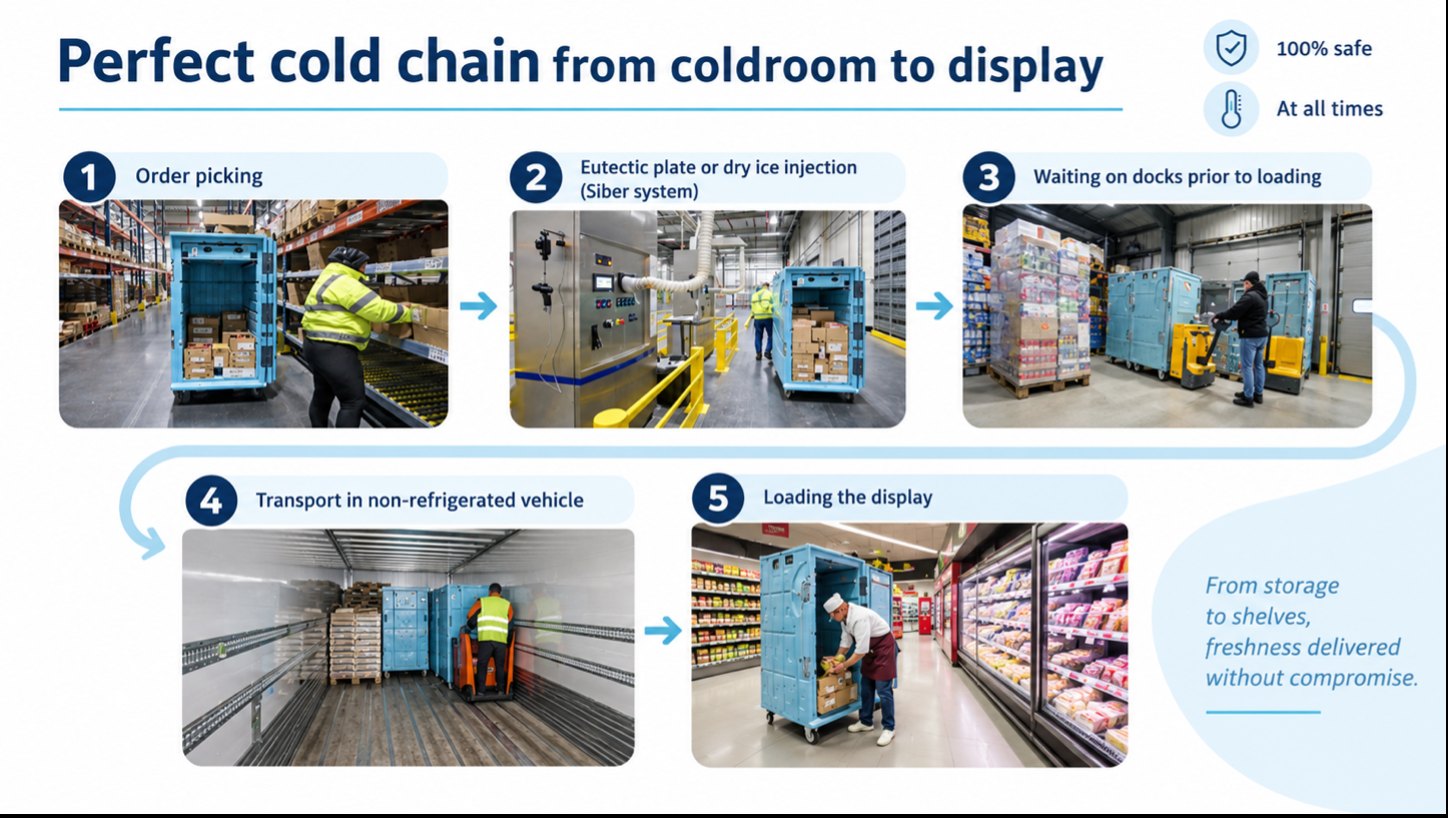
This approach can be particularly relevant to convenience retail, where delivery frequencies are high, store volumes may be relatively small, and several temperature categories must reach the same destination.
Scientific research on modular passive containers supports the potential for energy and emissions savings under certain partial-load conditions. Actual benefits depend on climate, loading patterns, equipment, routes and operating procedures.
3. Vietnam's regulatory framework: turning compliance priorities into operational opportunities
3.1 Food safety and temperature control
Law No. 55/2010/QH12 on Food Safety, particularly Articles 20 and 21.
Article 20 addresses food preservation, including the need to protect food against adverse environmental conditions and to maintain appropriate preservation conditions. Article 21 establishes requirements for food transportation, including maintaining the required preservation conditions throughout the journey, using appropriate transport equipment and preventing contamination.
For a convenience retailer, these provisions make the quality of the distribution process particularly important. Olivo insulated containers can support this objective by providing a defined thermal environment around the products, even when they are transported in an ambient vehicle. Separate containers can also help organise different temperature categories and support hygienic segregation, provided the operating procedures prevent cross-contamination.
The expected operational benefits include:
- Better control of product temperature during delivery.
- Reduced exposure to ambient heat during loading and unloading.
- More consistent handling procedures across stores.
- Improved ability to document temperature performance.
- Potential reduction in spoilage and product rejection.
Important: passive containers do not automatically establish compliance with food-safety requirements. The retailer must validate the actual configuration, ensure products are at the required temperature before loading, establish cleaning procedures and monitor temperature performance.
Reference: Law No. 55/2010/QH12 on Food Safety.
3.2 Energy efficiency and reduced dependence on diesel
Law No. 50/2010/QH12, amended by Law No. 77/2025/QH15, and Decree No. 30/2026/ND-CP.
The amended energy-efficiency framework and its implementing decree reinforce the importance of monitoring and improving energy use. For retailers, distribution is an operational area in which energy consumption can be influenced through vehicle utilisation, route planning, fleet selection and the organisation of temperature-controlled deliveries.
An Olivo-based model can contribute in two ways. First, it may reduce the number of separate delivery trips through the consolidation of ambient, chilled and frozen products. Second, it may allow selected deliveries to be carried out by ambient vehicles rather than vehicles requiring onboard refrigeration.
This can reduce diesel consumption associated with refrigeration and, where trips are eliminated, diesel consumption associated with vehicle propulsion. The overall impact must be calculated using actual fuel records, route distances, vehicle types, refrigeration operating hours and the electricity consumed in preparing eutectic plates.
Reference: Law No. 77/2025/QH15 amending the Law on Economical and Efficient Use of Energy.
Reference: Decree No. 30/2026/ND-CP on energy efficiency.
3.3 Environmental protection, packaging and circular economy
Law No. 72/2020/QH14 on Environmental Protection and the extended producer responsibility framework.
Vietnam's environmental legislation establishes a framework for waste management and extended producer responsibility. Decree No. 08/2022/ND-CP and subsequent amendments, including Decree No. 05/2025/ND-CP, are relevant to the implementation of extended producer responsibility requirements.
For convenience retailers, packaging is an important area to investigate because products often move through several stages of distribution before reaching the store. Reusable insulated containers may help reduce the need for certain single-use secondary transport packaging, including disposable insulated boxes, liners and protective materials, where these are currently used and can genuinely be eliminated.
However, the benefit must be demonstrated rather than assumed. Olivo containers are reusable transport equipment, not a universal replacement for all product packaging. Primary packaging and any packaging needed to protect food from contamination must remain in place.
A credible packaging-reduction assessment should measure:
- The number and weight of disposable packaging items eliminated.
- The number of reuses achieved by each container.
- Cleaning and maintenance requirements.
- Replacement rates, losses and end-of-life treatment.
- The net change in waste generated per delivery.
A reusable solution creates environmental value when its service life, rotation and actual substitution of disposable materials justify its manufacturing, transport and cleaning impacts.
Reference: Law No. 72/2020/QH14 on Environmental Protection.
3.4 Climate commitments and net-zero objectives
Decision No. 896/QĐ-TTg and Decree No. 06/2022/ND-CP, as amended.
Vietnam's National Climate Change Strategy to 2050 establishes a national objective of achieving net-zero greenhouse-gas emissions by 2050. The greenhouse-gas framework under Decree No. 06/2022/ND-CP, as amended, also provides a context for emissions measurement, mitigation planning and the development of carbon-market mechanisms.
A retailer does not automatically become compliant with every climate-related obligation by introducing passive cooling. Applicability depends on the organisation, the relevant requirements and its reporting obligations. Nevertheless, a properly documented cold-chain optimisation project can contribute to corporate emissions-reduction plans.
The most relevant measurements include:
- Litres of diesel consumed per delivery.
- Refrigeration fuel or electricity consumption.
- Total vehicle kilometres and kilometres avoided.
- CO₂-equivalent emissions per store delivered.
- Emissions associated with eutectic-plate preparation.
- Changes in food waste and packaging use.
These data can help retailers substantiate operational improvements and support their wider ESG and climate-reporting processes.
Reference: Decision No. 896/QĐ-TTg, National Climate Change Strategy to 2050.
Reference: Decree No. 06/2022/ND-CP on greenhouse-gas emission reduction, as amended.
4. A business case for a Vietnamese convenience store chain with 500 outlets
Let's consider a hypothetical retailer operating 500 convenience stores across Vietnam. The retailer wants to improve distribution efficiency while strengthening temperature control, reducing waste and advancing its environmental objectives.
The current operating model
Assume that ambient and temperature-controlled products are distributed through partially separate logistics flows. A store may receive one delivery for ambient goods and another for chilled or frozen goods. Vehicles may be relatively small, delivery routes may overlap, and refrigeration equipment may operate inefficiently when loads are incomplete.
For this business case, we use the following illustrative planning assumptions:
| Parameter | Illustrative assumption |
|---|---|
| Number of stores | 500 |
| Distribution days per year | 240 |
| Current annual delivery trips | 15,429 |
| Optimised annual delivery trips | 6,858 |
| Current annual transport cost | VND 36.5 billion |
| Optimised annual transport cost | VND 20.2 billion |
| Potential annual transport savings | VND 16.3 billion |
These figures represent a hypothetical scaled scenario based on an earlier distribution model. They are not audited results from a 500-store retailer and must be validated against actual routes, fleet capacity, delivery frequencies, staffing costs and service requirements.
The optimised operating model
- Consolidate temperature-controlled and ambient flows. Coordinate ambient, chilled and frozen inventory within a common distribution plan wherever operationally feasible.
- Use ambient vehicles more efficiently. Use appropriately sized ambient trucks for dry products and insulated temperature-controlled containers. Larger vehicles and night deliveries may increase the number of stores served per trip, subject to urban access and store receiving constraints.
- Introduce Olivo containers and eutectic plates. Select BOX, ROLL or BAC models according to product volumes, temperature requirements, route durations and handling conditions.
- Improve route planning and equipment rotation. Coordinate delivery windows, container preparation, cleaning and plate recharging. Ensure the number of containers available reflects actual rotation and peak demand.
- Introduce measurable food-safety and ESG indicators. Track temperature deviations, product rejection, breakage, packaging consumption, diesel usage and emissions alongside the traditional logistics cost indicators.
The expected benefit is not limited to refrigeration fuel savings. It is a more coordinated distribution system that may reduce delivery trips, improve product protection and provide better operational data.
5. The financial impact: an illustrative ROI calculation
Annual operating costs
| Indicator | Current model | Optimised model |
|---|---|---|
| Annual delivery trips | 15,429 | 6,858 |
| Annual transport costs | VND 36.5 billion | VND 20.2 billion |
| Potential annual savings | – | VND 16.3 billion |
Under these assumptions, the model indicates a potential reduction of approximately 55.6% in delivery trips and 44.6% in annual transport costs. These are scenario outputs, not guaranteed results. They depend on successful route consolidation, vehicle utilisation, warehouse organisation and the ability to maintain service levels.
Indicative investment in the Olivo solution
| Investment indicator | Illustrative amount |
|---|---|
| Indicative Olivo equipment investment | VND 24.4 billion |
| Potential annual transport savings | VND 16.3 billion |
| Simple payback period | Approximately 18 months |
The payback calculation is: VND 24.4 billion ÷ VND 16.3 billion per year = approximately 1.5 years.
This is a preliminary estimate, not a supplier quotation or a validated investment proposal. It assumes that the modeled savings can be achieved and sustained. The final business case must account for the required equipment mix, container service life, eutectic plates, electricity consumption, cleaning, handling, return logistics, fleet changes and implementation costs.
6. The additional value: food safety, lower breakage and less food waste
Food safety and reduced temperature risk
A validated passive cold-chain system can help protect products during loading, transport, unloading and repeated store deliveries. The retailer should monitor temperature deviations, product rejections, customer complaints and corrective actions before and after implementation. The objective is to reduce risk and improve control, not to claim that the use of insulated containers automatically prevents food-safety incidents.
Lower product breakage and damage
Reusable insulated containers can provide a defined protective enclosure for products during handling and transport. Depending on the product category and existing packaging, this may reduce damage associated with impacts, compression or repeated handling. The benefit should be assessed through product damage rates, rejected deliveries, return rates and the value of goods lost.
Less food waste
Improved temperature control can help limit premature deterioration of temperature-sensitive products when temperature excursions are a significant cause of loss. Reduced damage and more reliable delivery processes may also decrease the quantity of products discarded or rejected. To substantiate the result, the retailer should measure waste by product category and distinguish losses caused by temperature, handling, expiration, inventory management and other factors.
The financial benefit of avoided waste can then be added to the transport business case, provided it is not already included in the modeled savings.
7. Lower packaging consumption and stronger circularity
Disposable packaging can represent a recurring expense and a source of waste in retail distribution. Where reusable Olivo containers replace disposable transport packaging, the retailer may reduce purchases of certain single-use insulated boxes, protective liners or other secondary packaging.
The economic and environmental value depends on actual substitution, reuse frequency, cleaning and the container's lifespan. A credible pilot should measure:
- Kilograms of disposable packaging avoided per month.
- Number of container rotations.
- Packaging expenditure before and after implementation.
- Cleaning and maintenance costs.
- Container losses and replacement rates.
The result is a more robust basis for circular-economy reporting and packaging-reduction initiatives. The retailer should not claim that all plastic packaging is eliminated. The relevant achievement is the measured reduction in disposable packaging that can be removed without compromising product safety or quality.
8. Reduced diesel dependence and greenhouse-gas emissions
An optimised distribution model can reduce diesel consumption through several mechanisms. First, fewer delivery trips mean fewer kilometres driven. Second, selected routes may no longer require onboard refrigeration. Third, improved vehicle utilisation can reduce the number of vehicles required to deliver the same volume.
However, the net environmental impact must include the energy required to freeze eutectic plates, container cleaning, return movements and any additional handling or warehousing. A proper assessment should compare the full operating systems rather than simply comparing an ambient truck with a refrigerated truck.
The most useful indicators are:
- Litres of diesel per store delivered.
- Total annual diesel consumption.
- Refrigeration energy consumption.
- CO₂-equivalent emissions per delivery and per tonne delivered.
- Disposable packaging avoided.
- Food waste avoided.
These measurements can help the retailer identify practical contributions to its emissions-reduction objectives and wider net-zero pathway.
9. An integrated business case: measuring value beyond transportation
A comprehensive investment decision should include several sources of value.
| Value category | What should be measured |
|---|---|
| Transport efficiency | Cost per delivery, kilometres, trips and vehicle utilisation |
| Energy | Diesel consumption and electricity used for plate preparation |
| Food safety | Temperature deviations, rejected deliveries and corrective actions |
| Product quality | Breakage, damage and product rejection rates |
| Food waste | Quantity and value of discarded products |
| Packaging | Disposable packaging purchases and kilograms avoided |
| ESG | Net greenhouse-gas emissions and resource consumption |
| Resilience | Exposure to fuel-price volatility and refrigeration equipment failures |
Net annual benefit = transport savings + avoided product losses + packaging savings + other verified operating savings − additional operating costs.
Care must be taken to avoid double-counting. For example, if the original transport-cost model already includes product losses or packaging costs, those benefits must not be added a second time. The result should be a transparent total-cost-of-ownership analysis supported by operational data.
10. A practical implementation roadmap for a 500-store retailer
Phase 1: audit the current operation. Map warehouses, product temperatures, delivery frequencies, vehicle capacities, route distances, costs, waste and existing temperature-control performance.
Phase 2: design the optimised model. Evaluate warehouse consolidation, multi-temperature distribution, vehicle sizing, night delivery, container selection and equipment rotation.
Phase 3: run a controlled pilot. Select representative stores and routes. Compare the current and proposed systems using equivalent product volumes, service requirements and temperature specifications.
Phase 4: validate financial, quality and ESG outcomes. Measure delivery costs, diesel use, temperature compliance, product damage, waste, packaging and emissions. Calculate the total cost of ownership and payback using observed results.
Phase 5: scale progressively. Expand the solution only after confirming the operational and financial benefits and establishing the procedures needed for quality assurance, cleaning, tracking and equipment maintenance.
Conclusion: creating value beyond the cost of transport
For a convenience retailer operating 500 stores in Vietnam, passive cooling should not be evaluated solely as an alternative to refrigerated trucks. Its strategic value lies in the possibility of redesigning distribution around a combination of technologies that protects products, improves vehicle utilisation and reduces unnecessary resource consumption.
Olivo insulated containers may help retailers:
- Improve control of temperature-sensitive deliveries.
- Reduce exposure to temperature deviations and associated product losses.
- Consolidate selected ambient, chilled and frozen deliveries.
- Reduce the number of trips and dependence on diesel.
- Replace certain disposable transport-packaging materials with reusable equipment.
- Improve the measurement and management of environmental performance.
- Support corporate energy-efficiency and climate objectives.
In the illustrative business case, annual transport savings reach VND 16.3 billion, with a preliminary equipment payback of approximately 18 months. These figures must be validated through a route-level audit and a controlled pilot. The wider business case should also quantify food waste avoided, product damage reduced, packaging eliminated and net greenhouse-gas emissions avoided. These benefits are potential additional sources of value, not yet quantified in the financial scenario above.
The opportunity is to move from a transport-cost optimisation project to an integrated cold-chain transformation programme, one that combines operational efficiency, food safety, circularity and measurable progress toward a lower-carbon supply chain.
Provigood — We Do. You Grow. Authorized distributor of Olivo Cold Logistics in Vietnam and Cambodia.
Sources and references
- Law No. 55/2010/QH12 on Food Safety.
- Law No. 72/2020/QH14 on Environmental Protection.
- Law No. 77/2025/QH15 amending the Law on Economical and Efficient Use of Energy.
- Decree No. 30/2026/ND-CP on energy efficiency.
- Decision No. 896/QĐ-TTg, National Climate Change Strategy to 2050.
- Decree No. 06/2022/ND-CP on greenhouse-gas emission reduction, as amended.
- Law No. 72/2020/QH14 and Vietnam's extended producer responsibility framework.
Legal note: this article provides a business and operational perspective, not a legal opinion. Regulatory applicability and the latest consolidated legal texts should be verified before implementation.